OptiNod Academy
Funding Carry — A Trade That Swaps Price Risk for Basis, Liquidation, and Execution Risk
Delta-neutral funding carry swaps price direction for liquidation, execution, and funding-reversal risk. The moment funding is highest is also when that risk is largest. Basis is not, by itself, a loss already locked in.
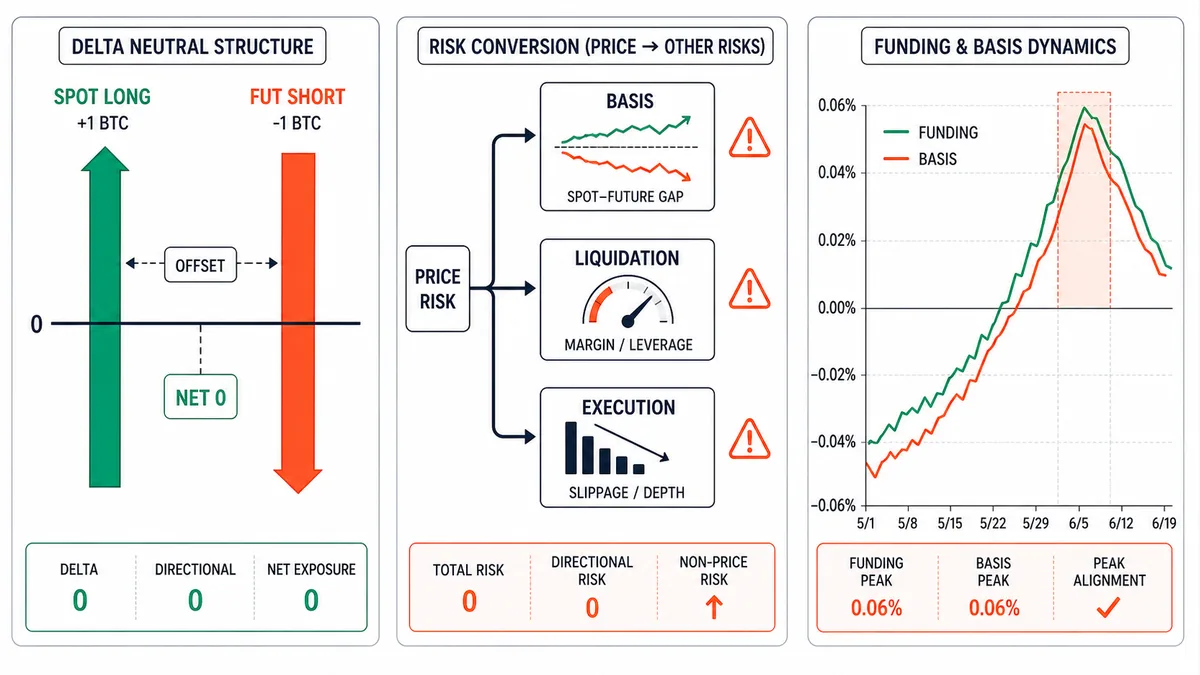
Collecting funding is a trade that removes price direction and takes on liquidation, execution, and funding-reversal risk instead. When funding is highest, that risk is largest too. A positive entry basis is not money you have already lost.
The definition of funding carry is simple. Buy 1 BTC of spot and sell 1 BTC of perpetual, and wherever price goes, the profit on one leg offsets the loss on the other. Net exposure is 0 — a delta-neutral state. With net exposure at 0, during a positive funding window the short perpetual leg collects funding every 8 hours.
When this definition reaches the public, one word gets attached to it: "free." Since it does not matter where price goes, the idea is that this is risk-free interest. A funding rate screen showing tens of percent annualized feeds that belief. So capital crowds into the futures short that collects the funding. As those shorts grow, they press the futures premium down, and the high funding on the screen does not last.
The problem is where that "free" comes from. Positive funding means the perpetual is priced above spot, which signals that the basis has widened. The basis widens the most when the market is overheated and long leverage has piled up on one side. That means the moment the funding rate is highest is exactly the moment that one-sided crowding is most extreme. So the funding rate should not be read as a yield metric — it should be read as a gauge of how far the market has tilted to one side. The funding chart and the basis-and-premium chart show the same phenomenon on two different axes (funding rate, basis and perp premium).

Delta May Be 0, But Basis Is Not
A spot long and a futures short with the same underlying quantity offset their common price-direction exposure but remain exposed to basis. Here B=F−S (futures price−spot price). For quantity q, combined price P&L before funding and costs is q×(Bentry−Bexit). Positive entry basis is not an immediate loss; it is a price gap that can produce profit if it later converges. This calculation assumes a spot long and a USDT/USDC-settled linear futures short with equal underlying quantities. Coin-settled inverse contracts require a separate P&L formula and hedge sizing.
Basis contraction after entry improves the combined spot-long/futures-short P&L; expansion worsens it. Entering at a high positive basis does not itself impose a loss, and convergence does not claw back funding. Perpetual futures have no expiry, however, so convergence is not guaranteed. Check margin capacity for further expansion and the risk of funding reversal.
Read basis separately from funding. The 1.5 times prior 30-day average condition below is an illustrative early-cycle filter, not a law that early entry is profitable or peak entry must lose. For every candidate, assess further basis expansion, funding persistence, costs, and liquidation headroom.

Liquidation Forcibly Unwinds Even a Delta-Neutral Position
The claim that it does not matter where price goes is only true while both legs are tied to a single account. In practice, spot and perpetual often sit in different margin pools, and if the short perpetual margin gets liquidated first during a sharp rally, only the directional spot long remains. At that instant the delta-neutral assumption is voided and only one-sided exposure is left.
On August 5, 2024, the day of the yen carry unwind, BTC fell from an open of $58,161 to an intraday low of $49,000 before closing at $54,019. In a volatility-explosion window like this, the margin on the futures leg gets eaten away in moments. Once the short side is liquidated, the carry is over and you are right back exposed to the directional risk you believed you had removed.
What decides success or failure in operation is margin allocation. Anyone who puts only the minimum margin into the short futures leg in isolated mode to collect maximum funding loses the short leg on the first volatility spike. Anyone who parks 30% or more of the entry value as buffer margin on the futures side rides out the same spike. The more a window risks liquidation cascades, the more this buffer is the core of protecting your return.

The Speed at Which Funding Flips Negative Is the Biggest Risk
Funding is not a fixed value that is set once and done. It is a variable recalculated every 8 hours. A position that was collecting on positive funding flips to negative funding the moment market sentiment tilts short, and from then on you pay funding instead of collecting it. A carry's return curve only slopes up while the funding sign holds.
During the FTX collapse in November 2022, BTC broke from an open of $20,591 on the 8th to an intraday low of $15,588 on the 9th. In a panic window like this, funding drops into deeply negative territory and the basis inverts (backwardation). A carry entered to capture positive funding goes beyond having collection stop — it turns into payment, and at the same time liquidation risk is at its greatest. The spot right after the overheated window where funding was highest is where this reversal often appears.
On the chart, watch the slope of the funding rate. Even when the absolute value is high, if the slope bends and heads toward 0, the collection window is ending. When open interest prints a new high while price stalls, it signals that the moment for one-sided longs to be flushed out is near, and the funding sign will flip before long (open interest).
Where Basis Normalization Shows Up in Your P&L
Total carry P&L adds cumulative funding to both legs’ price P&L and subtracts fees, slippage, and financing costs. Combined price P&L is q×(Bentry−Bcurrent), so entry basis of 0.4% of spot does not by itself create an immediate 0.4% unrealized loss. Unchanged basis gives zero price P&L before costs; contraction gives profit and expansion gives loss.
Basis-convergence profit and short-leg margin headroom are separate. If convergence accompanies a spot rally, combined P&L may improve while the short leg loses and runs short of margin. If futures fall to converge, the short leg gains. Convergence itself does not imply short liquidation; combined P&L alone cannot establish liquidation safety.
An Operating Example: Read Funding and Basis Together
Below is an illustrative BTC perpetual setup using a funding transition and the start of a basis cycle. These are not validated optimal rules; check costs and risk limits before using them.
- Entry: At the moment funding has just flipped from negative to positive and the basis crosses
1.5xits average width over the prior 30 days for the first time, fill spot long + an equal-size perpetual short simultaneously. - Margin: Put a minimum of 30% of the entry value as buffer margin on the short futures leg, keeping the liquidation price at least 25% away from the current price (no minimum margin in isolated mode).
- Stop: Keep the liquidation price at least 25% above the entry price. If spot rises +20% from entry, unwind both legs together before price reaches liquidation. Close first, before one leg is liquidated and leaves you with directional exposure.
- Take profit/management: One example cuts each leg’s size in half when cumulative funding collected reaches twice the held quantity times the entry-basis amount. That multiple is not a rule for recovering money already lost on the basis. It is a management mark that locks in a set amount of funding, and actual net P&L adds the change in basis and the costs.
- Invalidation: If funding flips negative, or the basis contracts below its average width over the prior 30 days, unwind both legs simultaneously. Leaving only one leg is prohibited.
This example uses cycle phase rather than funding magnitude alone. Skipping peak funding is intended to manage funding reversal, further basis expansion, and liquidation risk, not a loss from basis convergence. Early-cycle entry alone guarantees neither profit nor safety.
Even for the Same Asset, You Have to Watch Two Exchanges Together
A carry's basis and funding differ by exchange. If one exchange's funding is abnormally higher than another's, that gap is the result of that exchange's liquidation risk and order-book depth being priced in. The exchange offering the highest funding usually has the thinnest order book and the roughest liquidations.
How much slippage, fees, and liquidity eat into the funding you collected at the moment you unwind differs by exchange (slippage, fees, and liquidity). In a volatility-spike window, the thinner an exchange's order book, the harder it is to close both legs simultaneously at all. While one leg fills and the other slips, directional exposure appears for a moment.
Do not enter a carry before the following items are confirmed.
- Funding is right after a negative-to-positive flip and the funding rate's slope is positive
- The basis has just crossed
1.5xits prior-30-day average — the early stage, not the high - The short futures liquidation price is at least 25% away from the current price
- An exchange with an order book deep enough to unwind both legs simultaneously
- It is NOT the open-interest-new-high + price-stall combo (no reversal imminent)
Only when all five items are met can you weigh the funding you collect against liquidation, execution, and reversal risk. If even one item is missing, that risk has grown along with the funding you collect. Do not reread the basis as interest you have already paid.
