OptiNod Academy
Cross Margin vs. Isolated Margin — The Fork Where One Position's Liquidation Empties the Whole Account
Cross Margin buys you a later liquidation at the cost of opening a path where a single event empties the entire account. This covers how to pick between the two modes based on how far into the account a loss is allowed to reach.
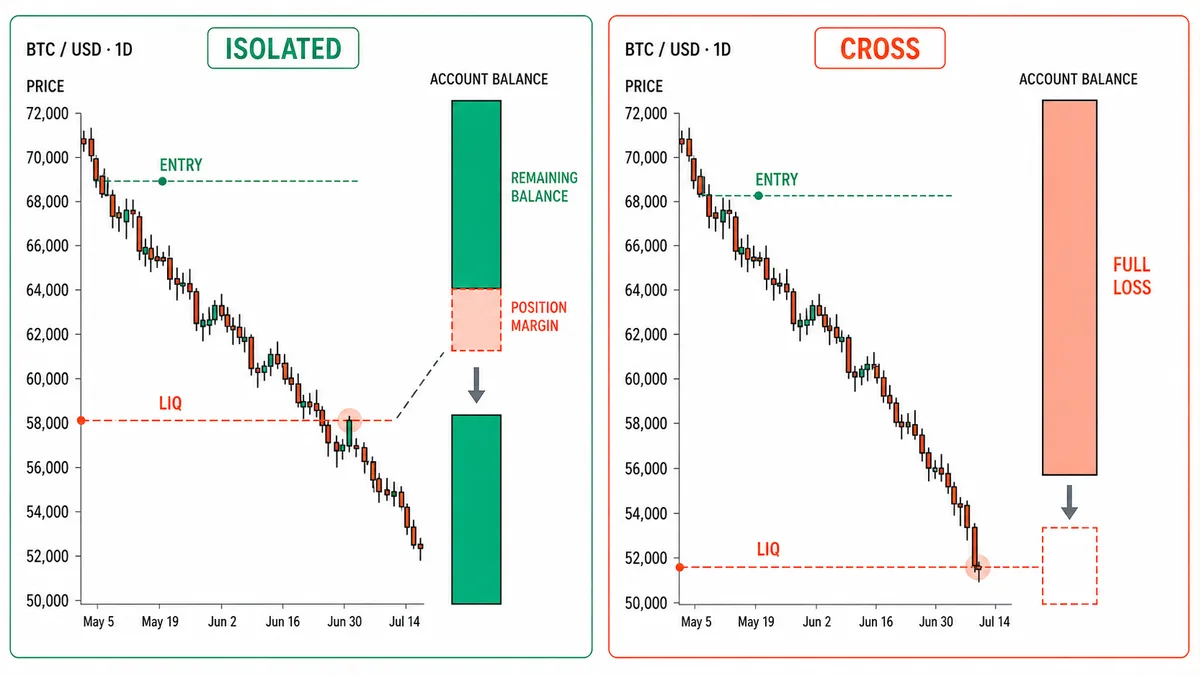
Cross Margin delays liquidation, but in exchange a single event can wipe out the entire account.
The line an exchange draws between its two margin modes is simple. Under Isolated Margin, only the margin you assign to that position is at risk, and when that margin is exhausted, that single position alone is liquidated. Under Cross Margin, the entire available balance of the account is mobilized as maintenance margin for every position. So even at the same entry price and the same leverage, the liquidation price differs. Because cross lets the entire balance absorb the loss, the liquidation price sits far further away.
The common reading stops right here. Cross has a distant liquidation price so liquidation rarely reaches it, isolated gets liquidated often, therefore cross is safer — that is the line of thinking. Exchange screens usually set cross as the default, which hardens the idea further. Taken in isolation, the fact that liquidation arrives later is not wrong.
The trouble comes from treating "arrives later" as the same thing as "loses less." Delaying liquidation means keeping the position alive into a deeper loss, and what gets mobilized as the buffer for that is the entire account balance, including other positions and unrealized profit. The depth that empties when liquidation does reach is fundamentally different between isolated and cross. This article reworks the two modes around the question of how far into the account a loss reaches.

A Distant Liquidation Price Under Cross Is Just the Result of Pulling in the Whole Balance
A distant liquidation price is not, in itself, a good thing. That distance exists because the exchange has pulled in the account's other funds to cover that position's loss. In isolated mode, if you assign $100 of margin at 5x leverage, you are liquidated at the point where that $100 runs out. Take the same position under cross with another $1,000 in the account, and the exchange holds the position until the full $1,100 is shaved away. The further the liquidation price moved, the more money you have staked on that one position.
The worst case under isolated is the $100 you assigned. The worst case under cross is the entire available account balance. Liquidation is something you never know when it will reach, and once it does, the amount that drains out is the loss. A distant liquidation price lowers the odds of reaching it, but when it is reached, the loss balloons to the whole account. What a trader has to manage is how much is lost when liquidation reaches. How often it reaches is the secondary question.
Look at ETHUSDT on February 3, 2025 and the difference becomes clear. That day ETH fell about 26% from an open of $2,869 to an intraday low of $2,125 before recovering to $2,880. On the close alone it was nearly flat, but while it passed through the low, an account holding a 5x ETH long in cross mode — if its liquidation price sat in that range — lost the entire account to a single wick (the tail) lasting only a few minutes. Under isolated it would have lost only the margin put into that position and could have ridden the recovery back with the remaining balance. Same chart, same wick, yet isolated ends in a partial loss while cross ends in a total loss.

Cross Wipes the Whole Account in a Single Event, Growing Risk of Ruin Asymmetrically
The core of risk of ruin is preventing any single event from taking the account to zero. When things are arranged so that a single loss takes only part of the capital, the same expected value yields a far higher probability of long-term survival. Cross Margin breaks exactly this structure. Because a single position's liquidation mobilizes the entire account balance, a single event can erase the entire capital.
The asymmetry comes from the difference in the size of the gain and the loss. Under cross, the gain is the chance of additional recovery while liquidation is postponed. What you lose under cross, when liquidation is hit, is the entire account. The gain you can get is limited, and the loss you can take is everything.
Holding several positions under cross at once makes the asymmetry worse. A sharp drop in one asset can shave the shared balance and pull the other positions' liquidation prices closer, which is a liquidation cascade.
Suppose you are long several altcoins with high correlation exposure under cross at the same time. One market-wide drop pushes every position toward its liquidation price at once, and the single shared balance carries all of that loss until it runs out.
The yen carry liquidation crash of August 5, 2024 is a representative example of this cascade. That day ETHUSDT fell about 21% from an open of $2,688 to an intraday low of $2,111, and BTC also fell from $58,161 to $49,000 the same day. Because crypto broadly collapsed at the same time, a trader holding BTC, ETH, and altcoin longs together in a cross account could not reduce risk through diversification. Every position lost in the same direction at once, and the shared balance bottomed out as it absorbed that combined loss all at once. Under isolated, each position would have lost only its own margin and stopped. When several assets crash together on the same bar, cross's shared balance erases the diversification benefit.
Because the Values Going into the Liquidation-Price Calculation Differ Between the Two Modes, the Same Leverage Carries Different Risk
The liquidation price depends on entry price, leverage, maintenance margin rate, and available position margin. Isolated margin uses only the margin assigned to that position, so losses on other positions do not directly drain it. Its liquidation price can still change with margin additions or withdrawals, position-size changes, funding deductions, or maintenance-margin changes. Cross margin shares the available account balance, so other positions can affect its liquidation price too.
For stop management, check assigned margin and liquidation price at entry under isolated, then recheck whenever margin, position size, or funding conditions change. For a long, keep the stop above the liquidation price with room between them. Under cross, losses on other positions can shrink the shared balance and pull liquidation closer, so monitor the whole account.
Let's look at it concretely. On a $1,000 account longing BTC at 10x, assigning $200 under isolated makes the notional $2,000, and that $200 is the liquidation ceiling. With the maintenance margin rate set at 0.5%, the liquidation price forms at a point about 9.5% below the entry price.
Take the same position under cross and the full $1,000 is the buffer, so the liquidation price forms much further down. It may look like cross holds on longer, but the money actually at risk is $200 versus $1,000.
For a trader who has decided via position sizing to put only 1% of the account on a trade, using cross renders that discipline useless. Even if you intended a $10 loss ceiling, the actual exposure is the entire account. Before entering, check whether the liquidation price is a fixed value or a moving one, and if it is a moving one, know that the loss ceiling you calculated is effectively meaningless.
The Only Places Cross Earns Its Keep Are Two-Sided Hedges and Hand-Managed Margin
Cross is not always a disadvantage. There are clearly places where it is used legitimately. In a hedge structure where you hold a long and a short on the same underlying at once and one is in profit when the other is in loss, cross's shared balance naturally offsets one leg's unrealized loss against the other's unrealized profit. In this case, taking each leg under isolated could liquidate one of them unnecessarily early.
The reason cross fits a hedge structure lies in the size of the net exposure. Because the two legs' P&L offset, the account's net exposure is small, and the shared balance only has to bear that small net exposure. This is the exact opposite of how cross stakes the entire account on one direction in a single-direction bet. Likewise, cross's spare margin is useful for someone who watches the account minute by minute and, as liquidation nears, immediately adds margin or trims the position. That said, this only holds on the strong premise that they never leave the screen.
Most traders fall under neither of these two conditions. For a trader holding a single-direction swing position who walks away from the screen, cross offers no benefit and only grows risk on one side. Outside of a hedge, cross's distant liquidation price is just the cost of widening the range a loss reaches to the entire account.

Setup — Pin Down the Loss Range by Tying Single-Direction Trades to Isolated
The approach this article most recommends is to make isolated the default on an ordinary single-direction trade, pinning down in advance the range a loss can reach when you enter.
- Mode selection: Enter single-direction positions under isolated. If the exchange default is set to cross, switch to isolated before entering.
- Size and margin: First size the position so the loss to the stop is 1–2% of the account. On a $1,000 account, that is a size that loses $10–20 when the stop is hit. Then assign isolated margin so the liquidation price sits below that stop. Margin is not the risk limit. It is the cushion that pushes liquidation behind the stop.
- Leverage: Lower the multiple so the liquidation price sits at least 1–2% further below the stop. Make the stop get hit first.
- Stop: Place the stop first at the price on the chart where this entry is wrong. Then set leverage and margin so the liquidation price sits at least 1–2% below that stop. Liquidation then stays as the emergency net if the stop slips.
- Invalidation: If a long’s liquidation price rises above its stop, add margin or reduce position size while retaining the remaining margin to move liquidation below the stop. Recheck the exchange’s displayed liquidation price and the gap to the stop after the adjustment.
Setup — Confine Cross to Same-Underlying Hedge Structures
Narrow the legitimate place for cross down to two-sided hedges.
- Condition: Use cross only when you hold a long and a short on the same underlying at once and the net exposure is small, at or below 30% of one direction's notional.
- Balance cap: Put only part of total capital in the cross account, and keep the rest in a separate account or withdraw it. Confine what a cross event can empty to that account's balance.
- Monitoring: If the two legs' net exposure widens past 30% in one direction, immediately trim one side to return to neutral.
- Invalidation: If you have to leave the screen for more than 30 minutes, close the cross hedge or switch it to isolated. An unmonitored one-directional cross exposure is not allowed.
Pitfalls — Commonly Misused Patterns
The illusion of reading cross as "safer because it rarely gets liquidated." Liquidation reaching later means holding into a deeper loss, and the amount that empties when it reaches is the entire account. In exchange for a lower frequency of reaching it, when it reaches once the loss grows to its maximum. If you see safety as "losing little even when it blows up," cross is the opposite.
The mismatch of calculating position sizing as if isolated while entering under cross. Even if you planned to put only 1% on a trade, under cross the actual exposure is the entire account. When the calculated loss ceiling and the amount you can actually lose diverge, the very estimate of maximum drawdown (max drawdown) becomes meaningless. To keep your sizing discipline, you have to set the mode to isolated first.
Confirm — Pre-Entry Mode-Check Checklist
The margin mode is a decision you have to lock down before pressing the entry button. The liquidation-price calculation, the sizing discipline, and the risk-of-ruin management all ultimately start from the mode choice. Check the following right before entering.
- Is this position single-direction or a hedge structure — if single-direction, isolated
- Is the exchange default mode NOT set to cross — confirm the switch to isolated
- Is the liquidation price formed at least 1–2% below the stop price
- Is this trade's maximum loss amount fixed at 1–2% of the account
- (If using cross) Is the net exposure at or below 30% of notional and is screen monitoring possible
Make isolated the default, and the event of the whole account emptying on a single wick never happens in the first place. Even a loss is only as much as the margin you assigned, and that is what leaves capital for the next trade.
