OptiNod Academy
Elliott and NEoWave: How to Track Multiple Scenarios
Use Elliott Wave not to guess the correct count, but to keep several scenarios open and eliminate the ones that fail first.
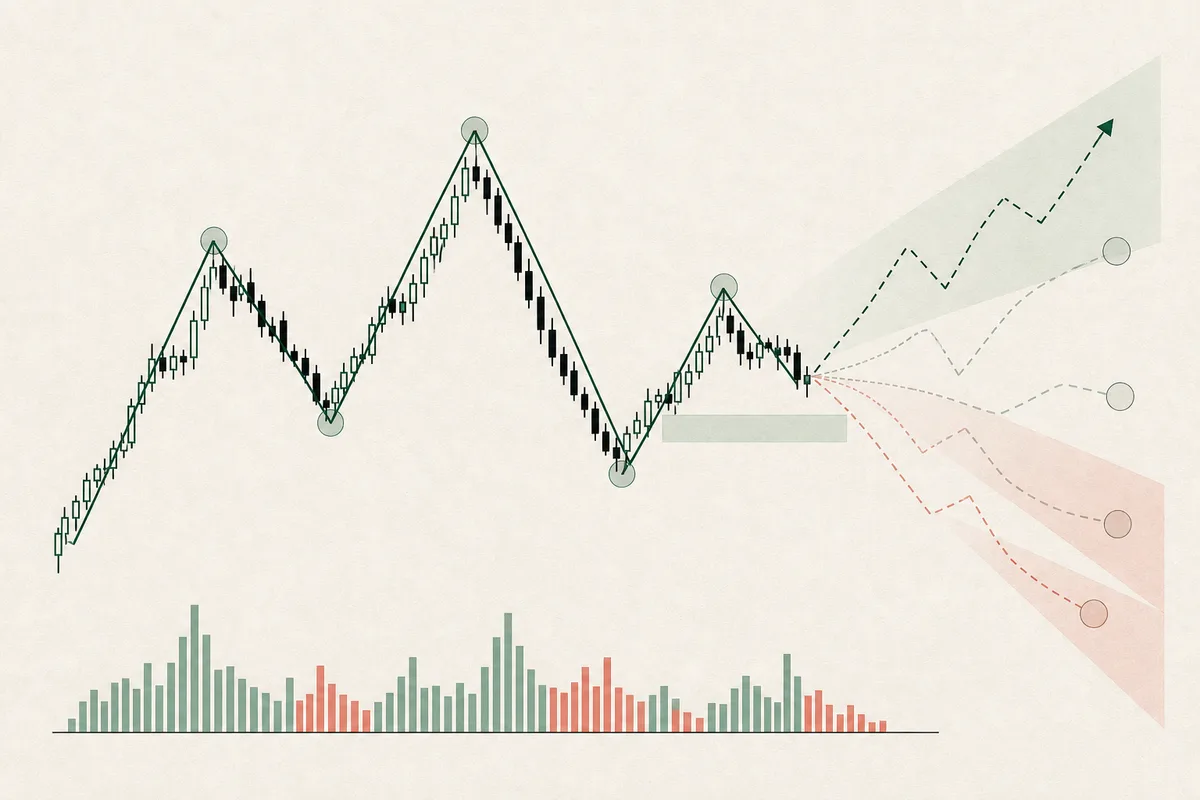
Elliott Wave is a tool for quickly dropping scenarios that are wrong. There is no need to chase the correct count.
Elliott Wave is often explained as a five-wave advance followed by a three-wave correction. On real charts, though, traders keep disagreeing over where wave 1 begins, whether the current move is wave 3 or wave C, and whether the correction is already over.
That's why treating Elliott Wave as a hunt for the one right answer is risky. A better approach is to keep several scenarios open at once and eliminate them one by one as their price and time conditions fail.
Before labeling waves, the conditions that keep this scenario alive are set first: which price has to hold, and by when the move has to develop.

In an impulse, most of the work happens in wave 3
In a bullish impulse, wave 3 is usually the strongest segment. If wave 3 does not extend much in price, and volume and momentum do not follow, the chance that the trend continues is lower. It is more likely that the move so far is a correction that ends in three waves, A, B, and C.
Not every move that looks like five waves is an impulse. If wave 3 is weak and wave 4 overlaps deeply into wave 1's price area, a correction may be getting counted as an impulse. Shape alone does not settle it. Each wave is checked against the conditions it has to meet.
For an orthodox impulse scenario, two things are checked. Wave 2 does not break below the start of wave 1, and wave 4 does not overlap wave 1's price area. Diagonals are treated separately. Whether wave 3 has extended enough is judged by this article's operating standard, set out below.

Corrective waves fall into zigzags, flats, and triangles
Corrections are usually the hardest part. A zigzag moves fast and deep, a flat has a deeply retracing B-wave, and a triangle shows contracting volatility. If you can't tell these three apart, you'll call the end of a correction too early.
In a zigzag, wave C may travel about as far as wave A or even more aggressively. In a flat, wave B can recover almost all of wave A or exceed its starting point. In a triangle, direction often remains unresolved until wave e is complete.
Knowing the difference changes the response, even when the correction is the same type of pause. Midway through a zigzag's wave C, a countertrend entry is not rushed. In a triangle, the breakout has to be confirmed first.

In NEoWave, one continuous move until price changes direction is called a monowave, and the larger structure built from those monowaves is a polywave. In simple terms, a monowave is one continuous move in a single direction, while a polywave is the larger structure formed by those moves. Degree refers to the timeframe scale of that structure. The distinction keeps a small five-wave move on a 5-minute chart from carrying the same weight as a large one on a daily chart.
Different corrective wave candidates require different confirmation conditions.
- Zigzag candidate: If wave C fails to reach even 0.8 times wave A and only drags on in time, calling the correction finished stays on hold.
- Flat candidate: Even if wave B recovers deeply near the start of wave A, the candidate is not thrown out right away.
- Triangle candidate: Until wave e ends and a close holds beyond the boundary, a directional entry waits.
How NEoWave differs from standard Elliott: after-the-fact confirmation and balance
Standard Elliott tends to focus on labeling waves while the pattern is still unfolding. NEoWave, as organized by Glenn Neely, insists on confirming the pattern afterward by watching what price does once it looks complete. This after-the-fact confirmation, or Post-Constructive Rule, is the first major difference between NEoWave and standard Elliott Wave.
The rule is simple. If you treat a segment as one completed wave, the move that follows must retrace it by a set amount within a set time. The requirement depends on the pattern. For an impulse, for example, price must cross back through the line joining the ends of waves 2 and 4, then retrace all of wave 5, and both steps must happen within the time wave 5 took to form. If the retracement is too shallow or too slow, the segment either isn't finished yet or was never one wave in the first place. The NEoWave post-pattern confirmation lesson covers the requirement for each pattern. Rather than declaring a five-wave move complete in real time, NEoWave confirms it afterward through the speed and depth of the retracement that follows.
The second difference is the rule of similarity and balance. Two adjacent waves must resemble each other in either price or time. If one wave is more than three times the other, or less than one-third of it, in both price and time, the count should be questioned. For example, if wave 3 is excessively small or large versus wave 1 in price or in time, grouping them as the same degree may be wrong. This balance check helps catch counts that rest on visual shape alone.
The third difference is defining the basic units objectively. NEoWave doesn't pick out monowaves by eye; it separates them with a consistent rule. A monowave ends the moment price changes direction, and the next one starts right there, however small the reversal. Retracement ratios come later, once the monowaves are counted, to judge their structure. Defining the basic units the same way means fewer cases of traders picking different wave-1 starting points on the same chart.
All three rules share one purpose: confirmation once the move is complete, not while it's still forming. In practice, the useful NEoWave question is whether the scenario passes the after-the-fact, balance and time checks. Declaring "this is wave 3" in real time is the weaker play.
Time matters as much as price
In NEoWave, time matters just as much as price. A scenario can still be holding its price level and lose strength by taking too long. If a wave 3 that should be accelerating drifts sideways instead, the impulse scenario weakens.
The hardest moments come when the stop level and the time condition conflict. Price may still be holding the wave 2 low, but if wave 3 fails to expand within the expected time window, the scenario has already lost strength. Then it's safer to cut size or stop adding until the next breakout is confirmed than to simply sit on the same stop.
Assume waves 1 and 2 have been confirmed in a bullish impulse scenario.Under this article's operating standard, a wave 3 candidate has to meet three conditions. It closes above the wave 1 high. The price distance of wave 3, measured from the end of wave 2, is at least 1.0 times the price distance of wave 1. That progress shows up within 1.5 times the time wave 2 took. This operating filter belongs to this article, and it is separate from the 5-bar standard in the basics chapter.Entry is confirmed on the first shallow retest after the break above the wave 1 high.The stop sits below the wave 2 low.If price breaks the wave 2 low, or if wave 3 fails to expand inside the time condition, the impulse scenario is discarded.


The Elliott trap is labeling every move
Being able to number waves isn't the same as being able to trade them. Count every small swing and the chart will always look like some kind of wave. The analysis gets more detailed while the trading decision gets murkier.
In live trading, only the larger structure and the current stop level stay in view. If this scenario is right, what has to be confirmed next? If that confirmation does not come, where is it thrown out? If those two questions have no answer, the count stays on hold for now.
Skill comes from eliminating wrong scenarios quickly
In Elliott and NEoWave, the core job is deleting scenarios quickly. Once a stop price breaks, time runs long, or a required condition is missed, the scenario is dropped without hesitation.
The right count is easy to see in hindsight. During the trade, there are only scenarios still in play and scenarios that have already failed. The real skill in Elliott analysis is how fast you eliminate the wrong ones.
