OptiNod Academy
Crab Pattern: The 1.618 Extension Is Where You Start Watching for a Reversal
Treat the Crab pattern not as a deep 1.618 extension alone, but as a narrow PRZ, a fast return from overextension, and a setup to abandon quickly if it fails.
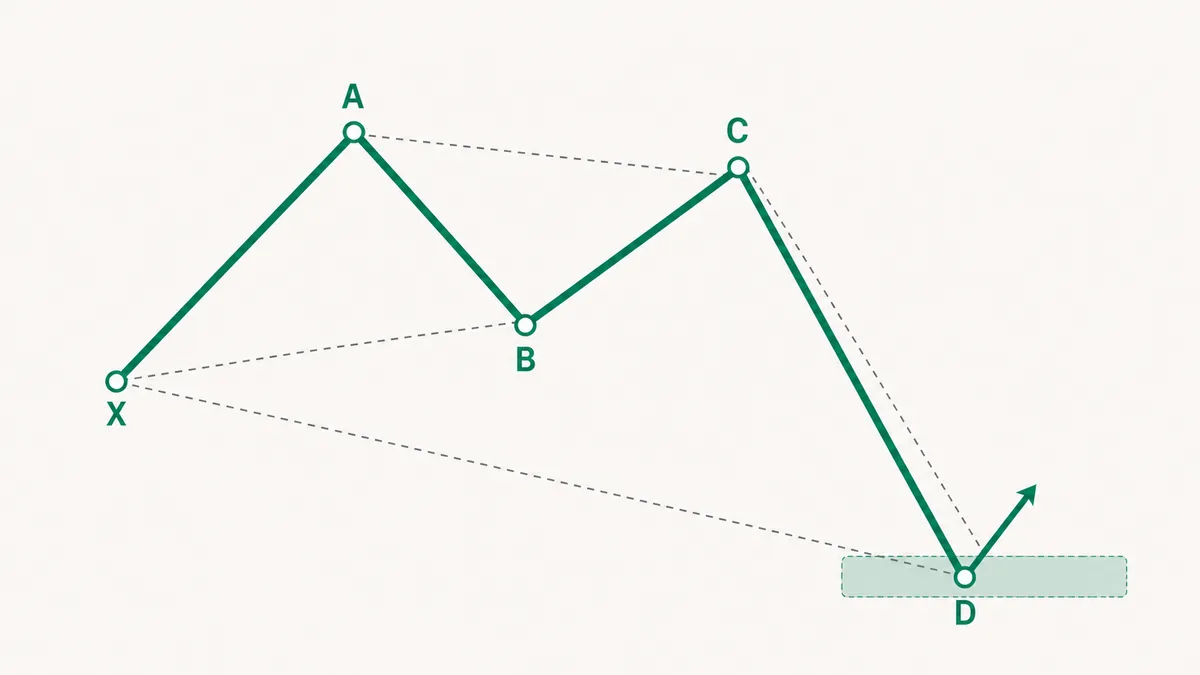
The Crab is the harmonic pattern whose D travels the farthest, and in practice it is also the one you must be ready to abandon the fastest.
The Crab pattern is built around D extending deeply toward the 1.618 extension of XA. When it works, the reversal can look large, which makes it an attractive countertrend candidate on an overheated chart.
But a distant D also means the prior move had strong momentum. To trade a Crab, you need to see whether the extension targets cluster tightly, and whether price rejects that zone quickly.
The 1.618 level is simply where you start watching, a marker that confirms nothing on its own. Decide whether to enter only after price returns inside the PRZ and gets rejected on the retest.

A Crab Candidate Forms When B Stops at a Moderate Retracement
In a Crab, B usually stops at 38.2–61.8% of XA. From 61.8% to 78.6% it is easy to mix up with a Butterfly, whose standard B is 78.6%, so separate them by the D extension ratio: the Crab is 1.618 and the Butterfly is 1.27. If B reaches as deep as 88.6%, it is called a Deep Crab on its own. If B is shallower than the usual 38.2–61.8% band, it is easy to read as leftover noise in the middle of a trend.
A Crab candidate takes shape only when B stops at a moderate retracement, C does not distort the structure too much, and D then extends strongly. The important point is whether the extension targets converge in one area. The distance D traveled means little on its own.
A Crab is a location where traders often feel both the urge to chase and the urge to fade the move. If B and C are unclear, it is safer to avoid an early trade and watch only the PRZ reaction.

The 1.618 D Point Is an Overextended Zone That Guarantees Nothing
The Crab’s signature number is the 1.618 extension of XA. This means the market has moved far beyond the original swing. A reversal may be near, but it may also be a sign that a strong trend is still in progress.
A good Crab PRZ brings the 1.618 extension, a deep BC extension, and an AB=CD variation target into a very narrow zone. If that zone becomes wide, the Crab quickly loses its edge. Because D is far away, even a small error can meaningfully change the stop distance and position size.
In an extension zone, judge by the close. Do not judge from the tail alone. If price only prints a tail and the close holds outside the PRZ, the trend has not yet lost its force.

If Price Does Not Return Quickly, the Crab Is Closer to Trend Continuation
Because D is far away in a Crab, risk builds as reversal confirmation gets delayed. If price pierces the PRZ but cannot return inside it quickly, start by considering trend continuation.
B is within the 38.2-61.8% range of XA.The D candidate forms near the 1.618 extension of XA.The 1.618 extension, BC 2.24-3.618 extension, and AB=CD target converge within 1.2% of the current price.After price pierces the extension PRZ, it closes back inside the zone within 1-2 candles.Confirm entry on the first retest after the return.Take the trade only if price cannot take out the D extreme.Place the stop 0.25-0.35 ATR beyond the D extreme.Even before the stop, two closes in a row outside the PRZ end the Crab scenario.
The Most Common Trap Is Assuming the Move Must Be Almost Over Because It Has Gone So Far
Distance traveled is not a reversal signal by itself. In fact, strong trends often attract more trend-following buyers or sellers precisely because price has already traveled far. When news or the higher-timeframe trend points in the same direction, the 1.618 extension may be only a level price passes through.
Another trap is trying too hard to distinguish a Deep Crab from a regular Crab. There is a definitional difference: in a regular Crab, B retraces 38.2-61.8%, while in a Deep Crab, B retraces as deeply as 88.6%. In live trading, however, PRZ width, return speed, and invalidation distance matter far more. If those three factors are unfavorable, the exact label does not help.

You do not need to force a distinction between the regular Crab and the Deep Crab because the execution criteria are the same. Both must return quickly from the extension PRZ, and both should be abandoned if price holds a close beyond D. In the end, the position is decided by return speed and stop distance. The harmonic label you choose has no bearing on it.
When the Crab works, the reward can be large. But that also means you need to recognize quickly when you are wrong. If you abandon the setup late, you can end up riding the deep extension against you as losses build.
If Price Holds a Close Beyond D, the Reversal Is Over
The stop is 0.25–0.35 ATR beyond D. Even before the stop, two closes in a row outside the PRZ end the Crab scenario. In a bullish pattern that place is a close held below the D low. In a bearish pattern it is a close held above the D high.
At that point, it is better to assume the market has accepted the extension. Do not keep drawing another harmonic pattern in the same area. Treat the Crab as one zone among many, not the final line of defense. If price cannot return inside the PRZ, treat that zone as an area the trend has passed through.
A failed read is not, by itself, a reason to chase immediately in the same direction. After price breaks through the extension PRZ, first confirm whether the first retest turns that zone into new support or resistance. If a failed reversal immediately turns into a trend-following entry, you can get hit twice from a late location. A failed Crab simply means “drop the reversal thesis and wait for the next retest.” Read it as a signal to step back, not to enter the other way.
